Cradles were among the most essential structures in Apache life. Designed for mobility, they allowed infants to be carried safely through rugged terrain, secured upright while mothers worked, traveled, or rode. In nomadic societies of the Southwest, portability was survival — and the cradle was engineered accordingly.
Toy cradles replicate that system in miniature.
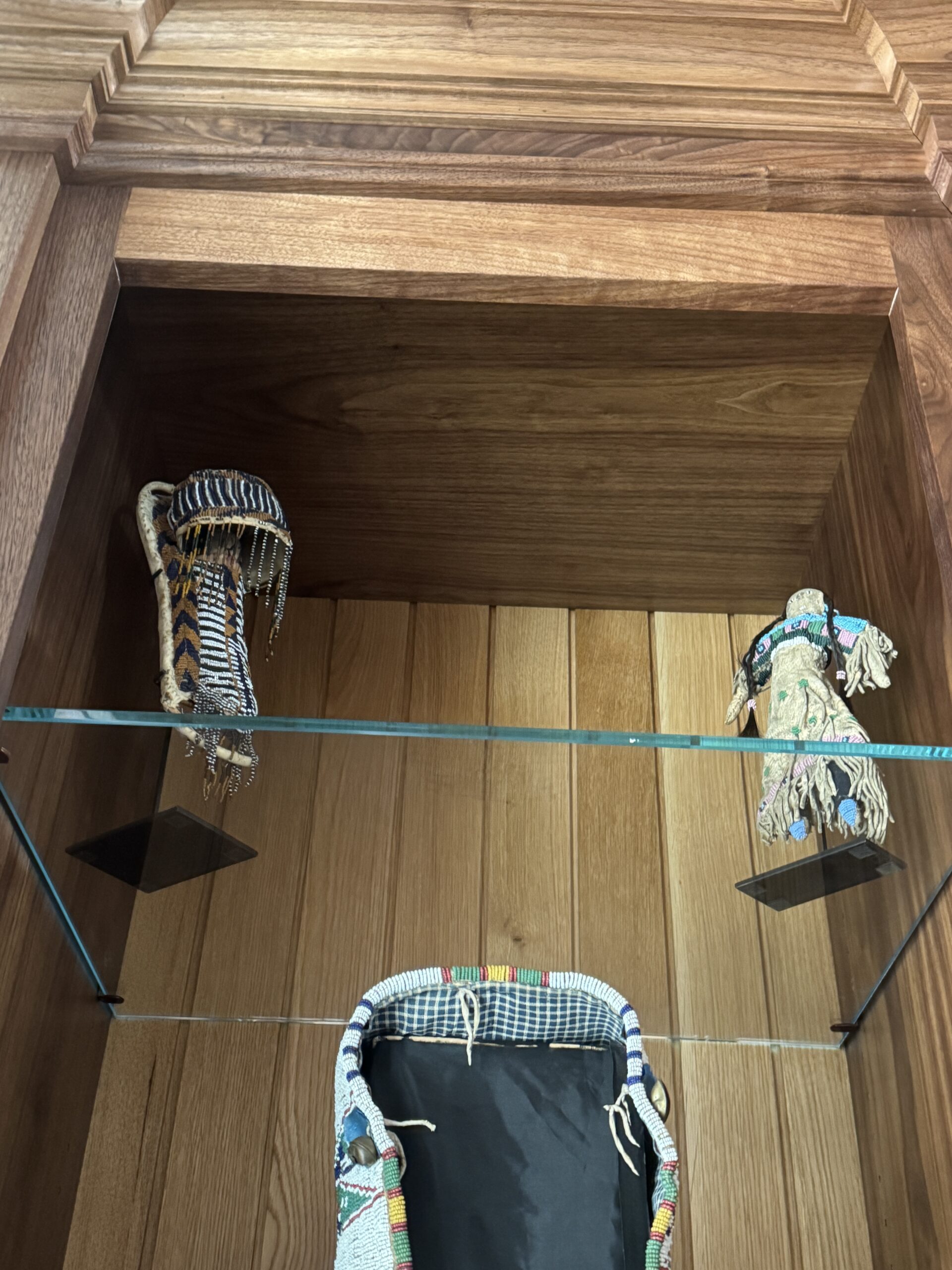
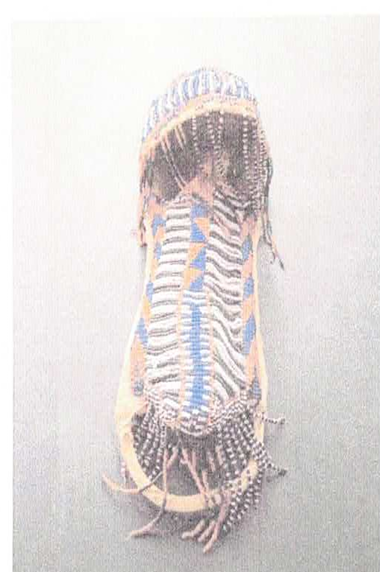
This example, constructed with willow slats along the back and a willow hoop forming the hood, closely follows full-size Apache cradle architecture. The structural logic is authentic: rigid support at the back, curved protection over the head, and secure lacing along the sides. It is not a simplified plaything — it is a scaled model of real engineering.
The surface is heavily beaded in classic Apache bead colors and patterns. By the late nineteenth century, Apache communities had integrated glass beadwork into earlier hide and fiber traditions, developing distinctive color palettes and pattern rhythms. The beadwork on this toy mirrors adult production, reinforcing design vocabulary from an early age.
Beaded drops along the hood edges animate the form, just as on full-size cradles. Movement was part of the visual language — even in play.
The presence of the original Apache doll is significant. Together, cradle and doll form a complete teaching set. Apache girls learned construction methods, bead placement, and social roles through imitation. The toy cradle was not merely entertainment; it was instruction in domestic architecture, childcare, and artistic responsibility.
By circa 1890, Apache communities were enduring forced relocation, military campaigns, and confinement. Yet objects such as this demonstrate continuity at the most intimate level. Even as external structures changed, cultural knowledge continued to be transmitted hand to hand.
The toy cradle represents a society rehearsing its future — ensuring that the knowledge of how to build, bead, and care would not disappear.
Small in scale.
Large in historical significance.