These moccasins were not made for display. They were made for distance.
Constructed from native-tanned buffalo hide uppers and rawhide soles, the pair shows clear evidence of wear — the kind that comes only from repeated movement across open ground. The rawhide soles would have hardened under use, shaping themselves to the terrain and to the wearer’s stride.
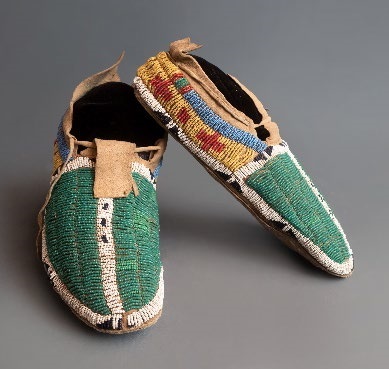
Across the vamps, wide lazy-stitched seed beads form bold green fields. The surface is vertically bisected and framed by white lanes, with flanking blue triangles and floating square elements. The design is decisive and structured, adhering to Northern Arapaho geometric logic of the mid-nineteenth century. The wide lazy stitch produces strong bands of color rather than delicate shimmer, reinforcing durability as much as ornament.
The heels are marked by a yellow bar punctuated with floating red crosses and finished with lavender trim — a chromatic combination that balances the dominance of green on the vamp. These details are placed where they would be seen as the wearer moved away, making the back view as considered as the front.
What distinguishes this pair is not pristine condition, but lived surface. Buffalo hide darkens and softens with time. Beadwork settles. Stitching flexes. These moccasins record the rhythm of walking — the quiet persistence of daily life rather than the spectacle of ceremony.
Circa 1860, Northern Arapaho communities were still largely mobile, traveling across traditional territories before the final imposition of reservation boundaries. Footwear was essential equipment. The artistry does not obscure function; it accompanies it.
These are not symbolic abstractions. They are evidence of miles.