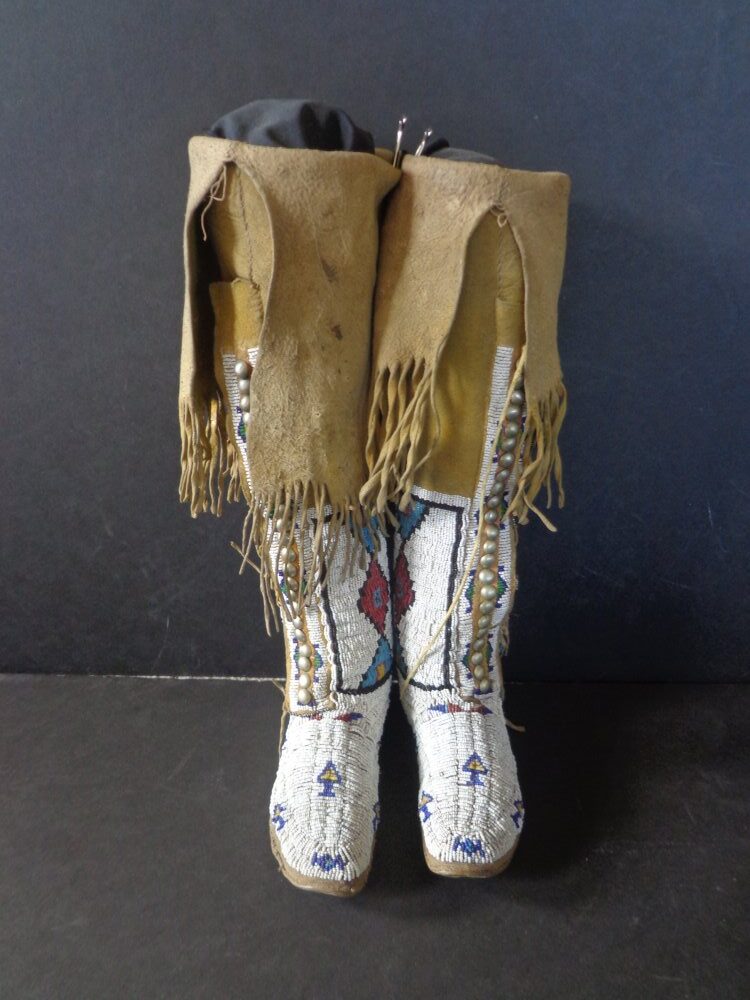
These were made for walking the Plains.
Standing fifteen inches tall, the moccasins rise well above the ankle, embracing the calf in sculpted buffalo hide. The surface is washed in yellow ocher, with red ocher strips running along the front—earth pigments that tie the wearer visually to land and ceremony alike. The color fields are not applied timidly; they ground the entire form.
Across a white beaded background unfold classic Cheyenne geometric designs executed in blue and red white-heart beads. White-heart beads—glass beads with a red core beneath a translucent outer layer—were highly prized in the nineteenth-century trade networks of the Plains. Their presence signals both access and refinement.
Most striking are the cobalt blue thunderbirds beaded on the vamps and sides. The thunderbird, a powerful cosmological being across many Plains cultures, is associated with storm, protection, and celestial authority. Positioned on the foot, the motif is not incidental. Each step carries symbolic force. Protection is woven into movement itself.
The tall shafts terminate in finely cut hide flaps around the calves—an elegant structural detail that introduces rhythm and articulation. In motion, these flaps would lift and settle, animating the silhouette of the wearer.
Women’s moccasins were not passive garments. They were declarations of artistic mastery. Plains beadwork was predominantly the domain of women, and footwear required both durability and compositional balance. The designs had to withstand wear while remaining visually precise.
Circa 1870, Cheyenne communities were enduring military campaigns and displacement. Yet artistry did not diminish. These moccasins demonstrate that even during instability, aesthetic systems remained confident and sophisticated.
They protected the body, certainly.
But they also marked identity with every step.