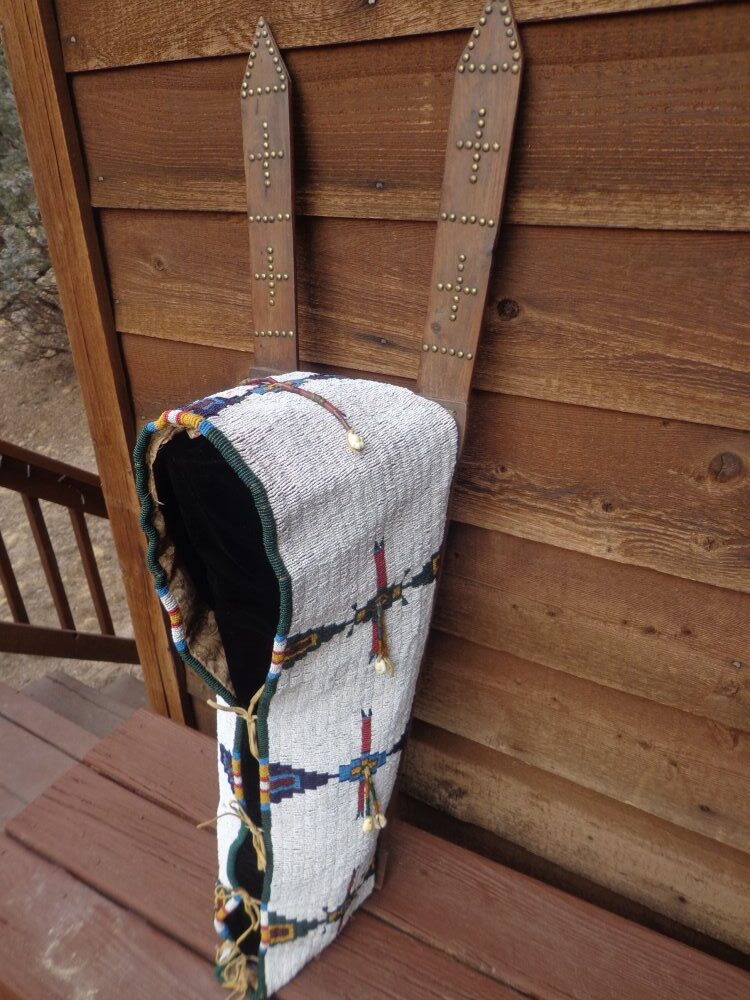
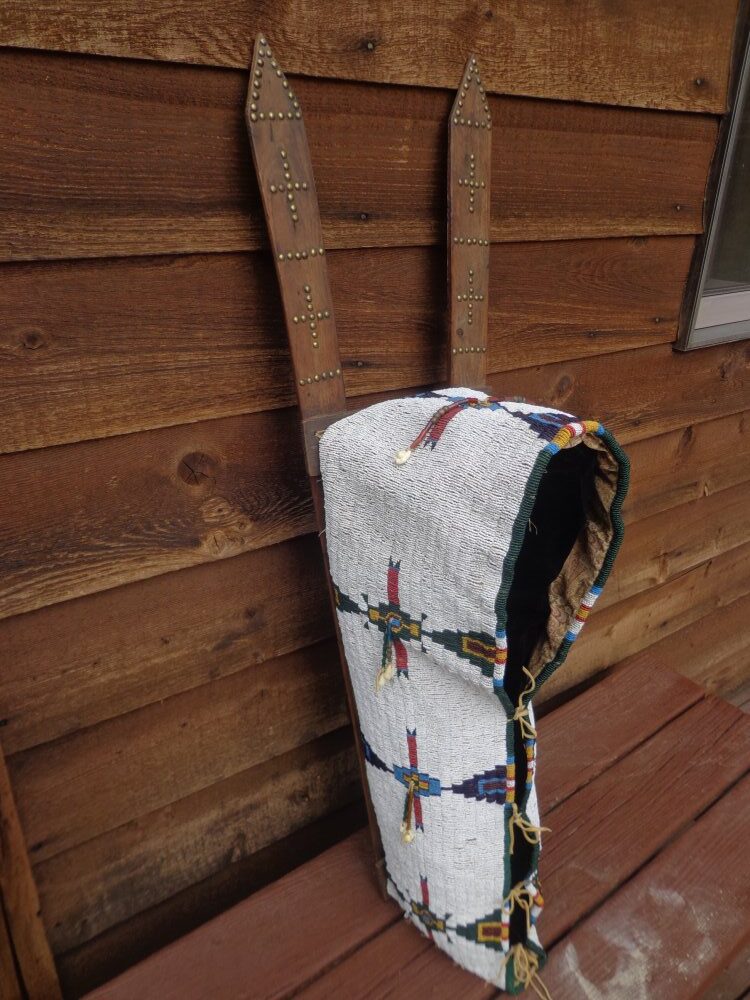
At forty-one inches tall, including its hand-hewn sticks, this Cheyenne cradle commands attention. It is not a modest domestic object. It is a public one.
Constructed on buffalo hide, the frame is formed from Osage orange wood—carefully shaped by hand rather than machined. The sticks are secured with early square-shanked brass tacks, small but deliberate flashes of trade-era metal that punctuate the structure. Such tacks were valued materials, and their placement transforms reinforcement into ornament.
The beadwork displays classic Cheyenne color relationships and design vocabulary, including recognizable Cheyenne tipi motifs. Tipi imagery carries layered meaning: home, mobility, lineage, and social belonging. To incorporate such designs onto a cradle places the child within that architectural and cultural continuity from the beginning.
The original buffalo lacing remains intact on both front and back—evidence of functional integrity as well as age. This is not a reconstructed piece; its construction speaks clearly of nineteenth-century Plains craftsmanship.
Suspended from the cradle are glass tube beads and cowry shells. Cowries, obtained through extensive trade networks, were associated across Plains cultures with wealth and spiritual protection. Their inclusion elevates the cradle beyond utility. It becomes a statement of family standing and care.
Inside, the original early trade cloth lining survives. Introduced textiles were absorbed into Cheyenne material culture without replacing Indigenous structural systems. Buffalo hide, lacing techniques, and beadwork patterns remain primary.
By 1870, Cheyenne communities were navigating escalating conflict and forced migration. In such a context, finely made cradles like this carried layered meaning. They presented the child to the community not only as protected, but as valued.
Ex California collection, this cradle stands as both domestic architecture and declaration: craftsmanship, wealth, identity, and continuity woven into the first structure a child would know.