Before beadwork dominated the Plains, there was painted rawhide.
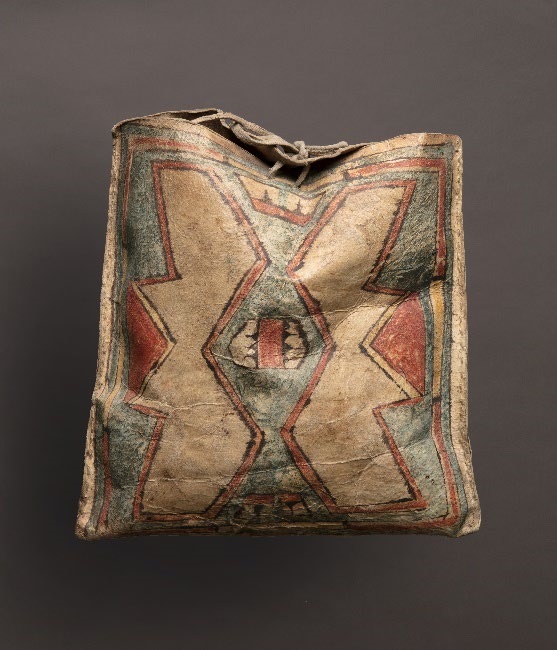
This Cheyenne parfleche case is constructed from buffalo rawhide, shaped, folded, and sewn along the side seams with native-tanned thong. Parfleche—stretched, scraped, and hardened hide—produced a lightweight but rigid container ideal for travel. These cases protected food, clothing, and tools while withstanding constant movement across open terrain.
The recto side is sealed with a triangular flap and painted with natural pigments. The design is spare but precise: a centered, vertically oriented triangle-diamond-triangle motif rendered in blue-green pigment, bordered by a red bar outlined in brown. The form floats in deliberate negative space, flanked by red and green triangular elements, and framed within a green and red border.
Nothing is accidental.
Cheyenne parfleche painting is a study in balance and symmetry. The geometry is not illustrative; it is declarative. These designs operate within a shared Plains visual system rooted in abstract order. Color relationships—red against green, blue against earth tone—create tension and containment simultaneously.
Unlike beaded works that shimmer in light, parfleche painting reads flat and graphic. It was meant to be seen quickly, from a distance, among stacks of similarly shaped cases in camp. Design helped identify ownership and tribal affiliation while reinforcing aesthetic discipline.
Circa 1860, this case predates the heavy reservation-era bead saturation seen in later Plains art. It belongs to an earlier design tradition where pigment and line carried the primary visual language.
Measuring approximately 11 by 11 inches and accompanied by a table stand, the case presents today as a sculptural object. Yet its original life was practical—stacked, loaded, transported.
It is container and canvas at once.