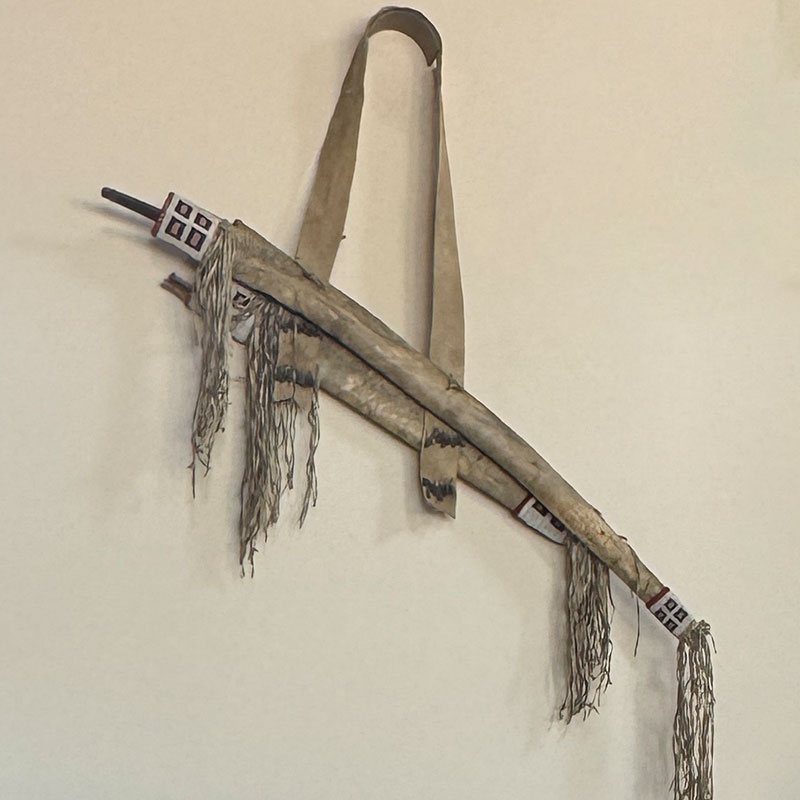
Before repeating rifles reshaped warfare on the Plains, the bow remained a primary instrument of both hunting and combat. The bow case and quiver together formed a warrior’s essential field kit — protection for the weapon and visible declaration of readiness.
Constructed on buffalo hide, this Cheyenne example reflects the material economy of the Plains. Buffalo supplied shelter, clothing, containers, and weapon housings. The bow case protected the sinew-backed bow from moisture and abrasion; the quiver secured arrows for mounted mobility.
The surface features classic Cheyenne “check board” beadwork patterns. Such designs are not merely decorative. Across Cheyenne material culture, geometric bead fields established tribal identity through repetition and rhythm. A warrior carried not only his weapons, but his nation’s design language.
The quiver contains four matched arrows with steel points and flared Cheyenne nocks. By the 1870s, steel points acquired through trade had largely replaced earlier stone heads. This object therefore sits at a moment of technological blending: traditional bow construction paired with introduced metal components.
Painted crests on each arrow are matched and retain strong color. Arrow decoration historically served as personal identification — marking ownership, recording symbolic meaning, or reflecting a warrior’s medicine associations. In battle, arrows were not anonymous.
Hide drops, tin cone dangles, and fringe animate the set. Movement and sound were integral to Plains martial presence. Tin cones, introduced through trade, produced a subtle metallic sound when in motion — part ornament, part announcement.
By 1870, Cheyenne communities were navigating accelerating military conflict and confinement pressures. Yet the bow and quiver remained embedded in hunting practices and in cultural memory long after firearms became dominant. Even when rifles were carried, bows continued to hold ceremonial and symbolic authority.
The bow case and quiver represent the structural core of Plains warfare prior to industrialization — a system dependent on skill, proximity, and horsemanship.
This set preserves that older martial architecture.