Ex. Colorado Professor’s Collection
This garment was not made quietly.
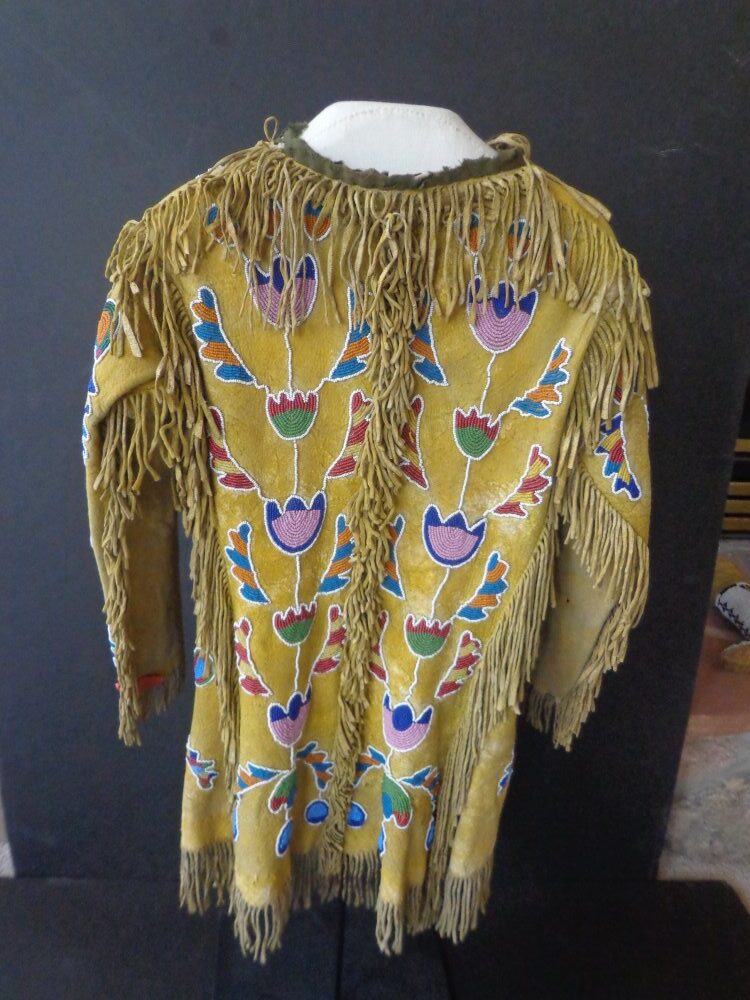
Fully saturated in heavy yellow ocher, the jacket radiates presence before beadwork is even considered. Yellow pigment on the Plains carried vitality, protection, and visual force. To apply it across the entire surface transforms the deer hide into something ceremonial rather than merely practical.
Across the front, back, and sleeves bloom abundant Crow floral beadwork—an aesthetic shift distinctive within Crow tradition. While many Plains tribes favored strict geometry, Crow artists of the late nineteenth century embraced bold, expressive floral forms. These designs are not timid embellishments. They occupy space confidently, asserting artistic fluency and access to materials.
The jacket is edged with abundant yellow fringe along the front, back, arms, and shoulders. Fringe amplifies movement. On a boy, it magnifies scale—each gesture enlarged, each step animated. The garment prepares the wearer for public visibility.
Ribbon work accents the neckline and cuffs, introducing trade textiles into the composition without overpowering Indigenous structure. By 1880, ribbon and stroud wool had become integrated into Plains clothing, yet here they operate as framing devices rather than replacements.
The suggestion that this jacket was made for the son of a high-ranking chief or warrior is plausible not simply because of its refinement, but because of its ambition. The labor invested—full pigment saturation, extensive beadwork coverage, generous fringe—signals status. Such garments were not everyday play clothes. They were statements of lineage and expectation.
Crow society valued bravery, generosity, and public display. A boy raised within a prominent family would be introduced early to the visual language of prestige. Clothing served as rehearsal. Identity was not postponed until adulthood; it was cultivated.
This jacket embodies that cultivation — a child clothed not only in color and pattern, but in anticipated leadership.