For the Crow, the horse was not merely transportation. It was wealth, status, strategy, and survival. After the horse was introduced to the Plains in the eighteenth century, it reshaped social hierarchy and warfare. Among Crow communities in particular, horsemanship became a defining cultural strength.
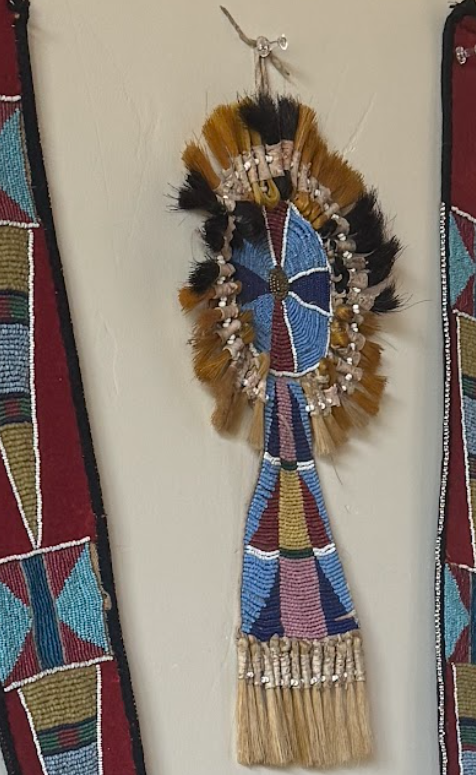
The horse keyhole — worn on the forehead as part of the bridle — was both adornment and declaration.
This example reflects classic Crow bead color relationships and geometric precision. The circular rosette form anchors the design, while the elongated lower panel and fringe extend downward over the horse’s face. When mounted, the piece would have moved rhythmically with the animal’s stride, animating color and pattern in motion.
The rosette and lower section are further embellished with hide-wrapped horsehair. Horsehair decoration reinforced the relationship between ornament and animal — the horse adorned with elements derived from itself. Such materials were not incidental; they deepened the symbolic bond between rider and mount.
Historically, horse regalia served as visual currency on the Plains. Successful horse raiders increased wealth and influence. A finely decorated horse announced both access to skilled female beadworkers and ownership of prized animals. Crow warriors were widely recognized for their horsemanship and raiding skill, particularly in the later nineteenth century when horse wealth became increasingly concentrated.
By the 1880s and 1890s, as reservation boundaries limited territorial movement, equestrian regalia shifted from purely martial contexts into ceremonial and parade use. Yet the aesthetic language remained rooted in the mounted warrior era.
The keyhole ornament transforms the horse into a participant in display. It makes the animal a bearer of tribal identity.
If breastplates marked authority on the human body,
horse keyholes marked authority in motion.
This piece represents the public face of equestrian culture — where wealth, artistry, and power rode together across the Plains.