Crow regalia was never shy.
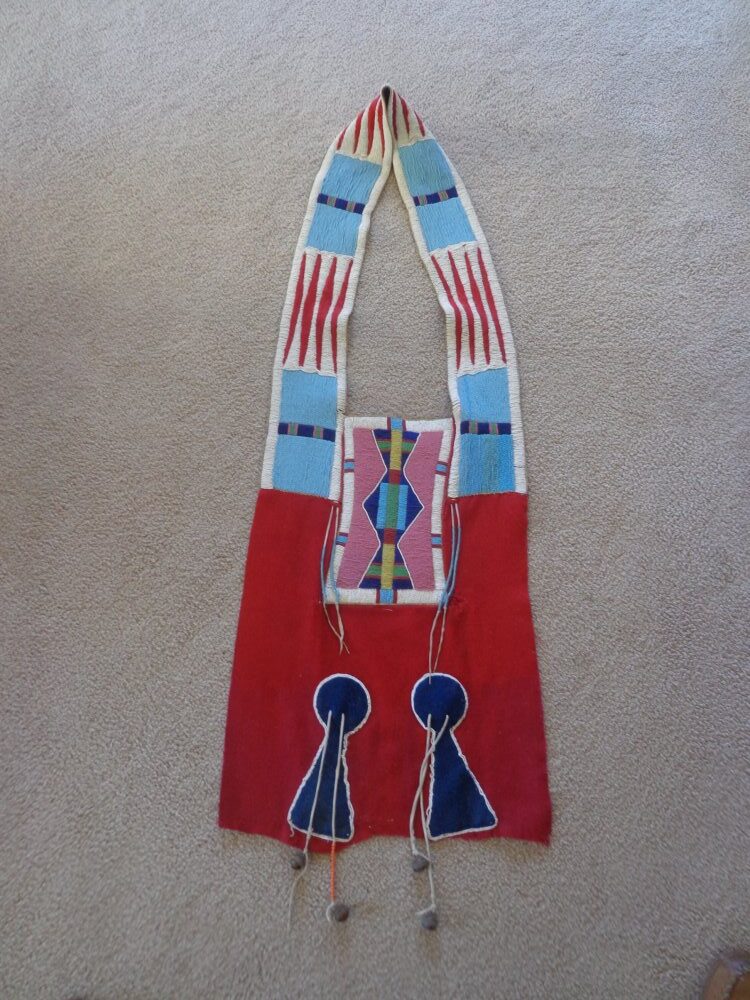
This bandolier commands attention through bold color architecture and confident asymmetry. The front panel is fully beaded in classic Crow color relationships—high-contrast arrangements that emphasize clarity and visual punch rather than subtle modulation. Crow beadwork of this period is known for its assertive geometry and chromatic intensity, and this piece adheres to that tradition with conviction.
The shoulder strap is entirely beaded, interrupted by distinctive “slash” marks executed in early trade stroud cloth. These slashes are not accidental tears; they are deliberate insertions of saturated wool that create sharp visual breaks along the strap’s length. Stroud—deeply colored trade wool—was prized across the Plains, and its use here introduces a bold textile counterpoint to the bead surface.
At the base of the bandolier, a red stroud panel anchors the composition. Over it lies blue trade stroud cut into a striking “keyhole” motif—an unmistakable Crow design element that reinforces tribal identity at a glance. The interplay of red and blue cloth, beadwork, and negative space produces layered depth rather than flat ornament.
Suspended from the front are early beaded drops. As with many Plains adornments, these elements animate the object in motion. Worn across the chest during dances, ceremonies, or public gatherings, the drops would sway and lift, amplifying the wearer’s presence.
By the 1880s, intertribal warfare had diminished under federal enforcement, but competitive display had not. Among the Crow, visual brilliance remained central to expressions of identity and prestige. A bandolier such as this was not simply a functional sash; it was a statement piece—designed to be read from across a camp circle.
Here, bead, wool, and movement converge into one message: look.