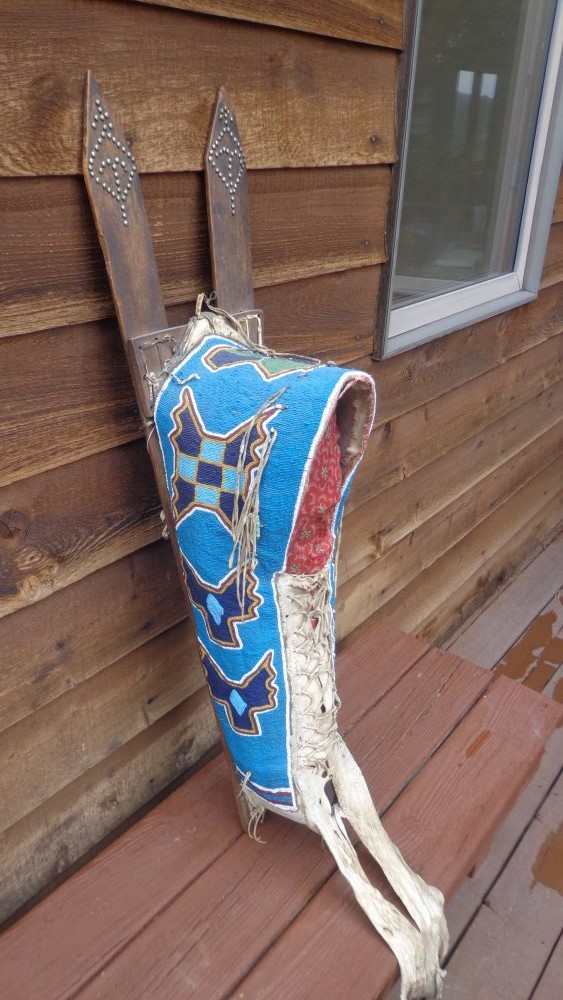
This full-size Kiowa cradle reflects both structural intelligence and refined beadwork tradition at the close of the nineteenth century.
Constructed with a frame of Osage orange sticks—wood prized on the Southern Plains for its strength and resilience—the cradle was engineered for durability and mobility. Osage orange bends without easily breaking, making it ideal for objects meant to endure movement across varied terrain. Laced through the frame are rows of German silver shoe buttons, creating a rhythmic metallic accent that adds both visual brilliance and subtle sound when in motion.
The beaded surface is set against a vivid blue ground, a color frequently favored in Kiowa beadwork of this period. Across this field run bifurcated geometric forms and checkerboard patterning, executed with precision and strong symmetry. Most notable is the inclusion of a rare Kiowa “oak leaf” motif—an important regional design element that situates the cradle firmly within Kiowa aesthetic tradition. These motifs were not arbitrary decoration; they expressed tribal identity, visual order, and cultural continuity.
At the base, the classic Kiowa footboard is extended with hide panels fashioned from the legs of a deer hide. These extensions provided protection and flexibility while maintaining the cradle’s structural integrity. The form allowed an infant to be secured upright—shielded from the elements while remaining part of daily life and community activity.
Created during the reservation era of the 1890s, this cradle represents persistence of Kiowa design authority despite profound social and political change. Introduced materials such as glass seed beads and German silver were incorporated seamlessly into established Indigenous frameworks of form and pattern. The result is neither transitional nor experimental—it is confident.
Ex John Painter Collection, Cincinnati, Ohio, this cradle is illustrated in American Indian Artifacts: The John Painter Collection (pp. 108, 110) and A Window on the Past: Farl Native American Dress from the John Painter Collection (p. 58).
A cradle is among the most intimate objects in Plains material culture. This example demonstrates that even objects created for the earliest stages of life were executed with artistic discipline and structural sophistication.