There is no ambiguity in this object.
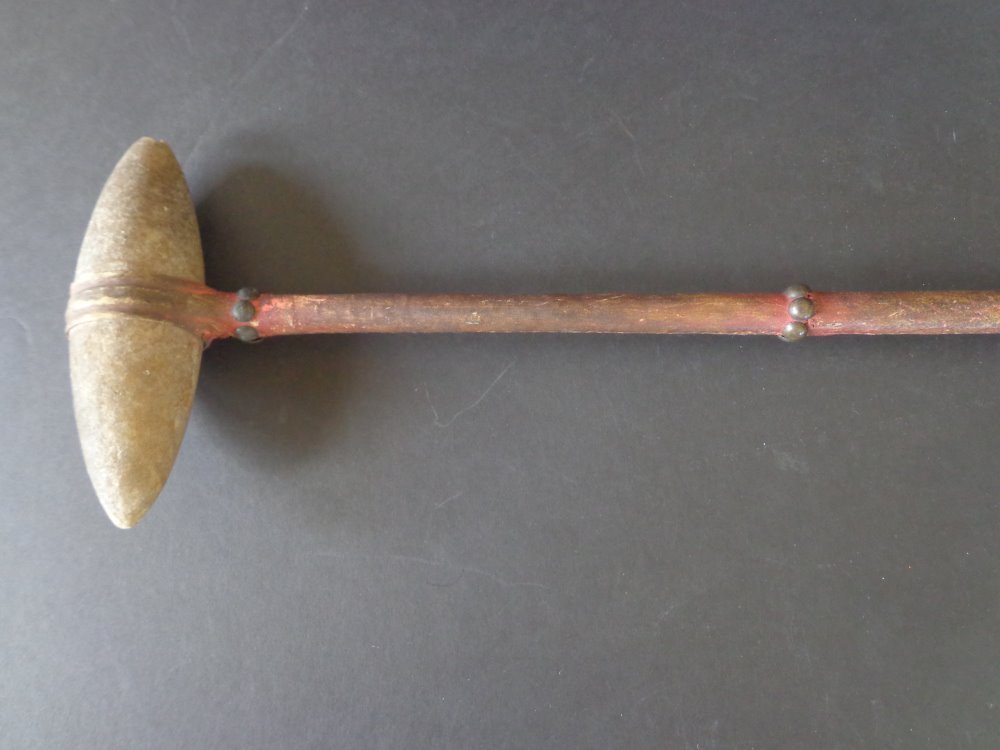
This Northern Plains horse club was made for mounted combat — designed to deliver concentrated force from horseback. Measuring approximately 32 inches in length (excluding the horsehair drop), the club’s proportions balance reach with control. In motion, it would have been swung from the saddle with decisive efficiency.
The head is formed from quartz, a hard, dense stone capable of delivering shattering impact. Unlike later metal weapons, this form relies on weight distribution and momentum. The stone head is secured to a wooden shaft that has been washed in red ocher — a pigment long associated with vitality, warfare, and protective power across Plains cultures.
Decorative tacks punctuate the shaft. Their placement is spare but deliberate, introducing small metallic flashes along the red ground. Even weapons carried visual authority.
Suspended from the end is a horsehair drop. As with many Plains martial objects, this element introduces movement and visual animation. In battle, it would trail and lift, reinforcing the club’s presence. Ornament does not soften the weapon; it amplifies it.
Often referred to as a “head breaker,” the term is not figurative. Clubs of this type were intended for close combat — particularly in mounted encounters where speed and shock determined outcome.
This example, with its quartz head, red-ochered shaft, and intact horsehair drop, represents a direct expression of Plains martial engineering: no excess, no hesitation, no confusion of purpose.
It is weight, balance, and impact — held in one hand.