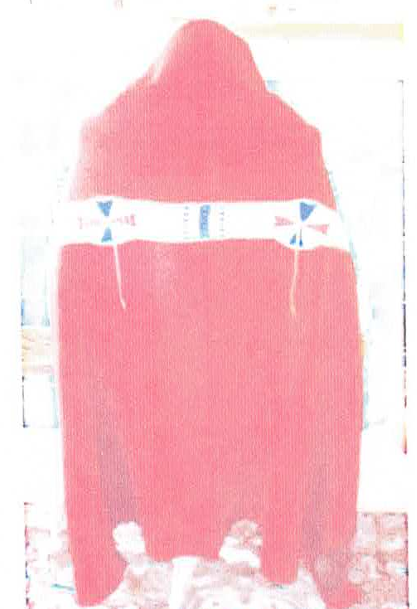
Trade blankets were among the most transformative materials introduced into Plains life during the nineteenth century. By the 1870s, wool blankets had largely replaced buffalo robes for everyday warmth, becoming essential garments, bedding, and outerwear. They were practical, durable, and portable — perfectly suited to Plains conditions.
This example, however, carries an unusual and historically charged marking: “USID,” standing for United States Indian Department.
In the early 1870s, the U.S. government began stenciling blankets distributed through treaty and ration systems. The marking was intended to discourage resale and unauthorized trade, particularly the exchange of government-issued goods for whiskey. Legally, possession of a “USID” item by a non-Native individual was prohibited.
The mark had consequences beyond regulation. Many Lakota and other Plains people objected to the visible branding. It publicly identified the wearer as a recipient of government issue — a label tied to reservation dependency at a time of extreme political pressure. The stenciling program was short-lived, discontinued after several years due to resistance and dissatisfaction.
The blanket itself is red — a less common color than the widely distributed blue trade blankets. Red carried strong visual impact on the Plains and was frequently associated with vitality, power, and martial identity.
What elevates this example further is the addition of a fully beaded buffalo-hide blanket strip. The strip features a white beaded ground accented with blue, greasy yellow, and red white-heart beads — all materials central to nineteenth-century Sioux beadwork traditions. The patterns are consistent with typical Sioux geometric design language of the period.
Four beaded rondelles with yellow-ochred twisted fringe drops hang from the strip. Rondelles often functioned as visual focal points, and their placement along the blanket edge would have introduced movement and dimensionality when worn.
The addition of beadwork transforms a government-issued ration item into a personalized garment. It asserts aesthetic sovereignty over a controlled commodity. The wool may have been distributed by federal policy, but the surface became Indigenous space.
By the 1870s, Sioux communities were living through intense upheaval: treaty renegotiations, military campaigns, confinement to reservations, and the destruction of buffalo economies. Trade blankets became part of daily life, but this example demonstrates adaptation rather than passive acceptance.
This object holds tension:
– Government distribution and regulation
– Visible federal branding
– Indigenous modification and reclamation
– Continued artistic authority
It is a document in wool.
Not a treaty on paper —
but a record of power dynamics worn across the shoulders.
Few objects encapsulate the reservation-era shift as clearly as a stenciled blanket that has been deliberately beautified.
This is material evidence of negotiation, resistance, and cultural persistence.