Rosebud Reservation, South Dakota
The hair pipe breastplate emerged in the mid–late nineteenth century as a defining element of Plains male regalia. Worn across the chest, it functioned as both ornament and armor — a rigid, protective layer over the vital center of the body.
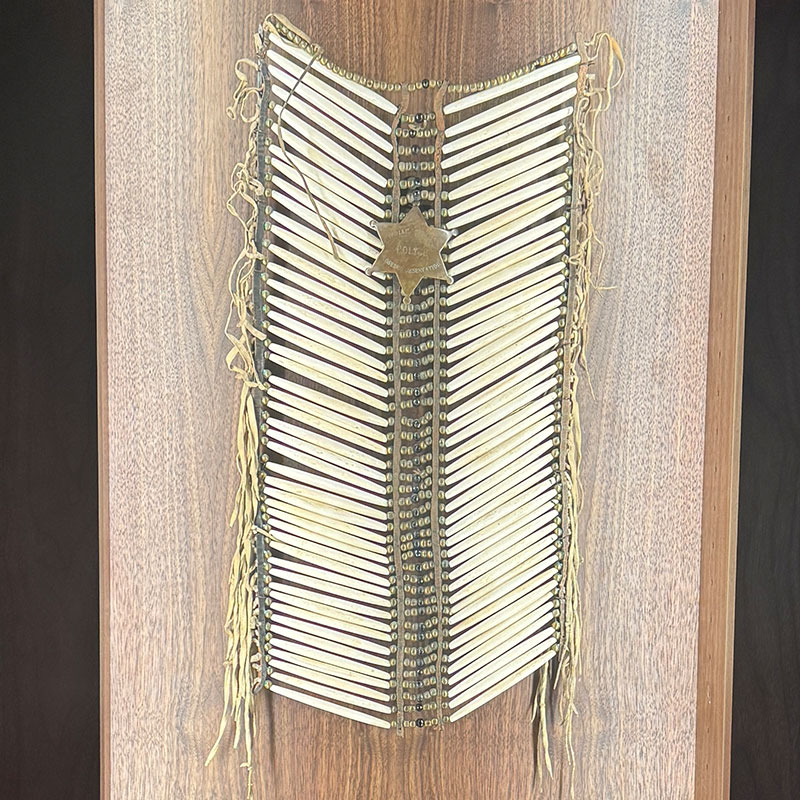
Constructed from bone hair pipes laced through commercial saddle leather, this example reflects a synthesis of Indigenous form and trade materials. The long tubular beads — originally derived from shell and later manufactured in bone for trade — became highly valued across the Plains. By the 1870s, they were central to men’s ceremonial and leadership attire.
The vertical alignment of the pipes creates a flexible but structured surface. Historically, breastplates were believed to offer spiritual as well as physical protection. The chest was the seat of breath and life force; covering it was symbolic as much as practical.
Brass beads accent the saddle leather sides, adding metallic brightness and reinforcing status through access to trade goods. Such materials circulated widely through reservation economies after the buffalo herds collapsed and military campaigns forced confinement.
This example retains its original early brass badge reading, “Indian Police Rosebud Reservation.” That detail situates the breastplate within a profound transitional period. Reservation Indian Police units were established by federal authorities to maintain order within reservation boundaries.
Members were often respected warriors or community figures operating within a new colonial administrative framework.
The presence of the badge transforms the meaning of the object. The breastplate — once associated primarily with intertribal warfare and martial prestige — here becomes part of an adapted authority structure under U.S. oversight. It signals continuity of leadership aesthetics within a dramatically altered political system.
Historically, hair pipe breastplates outlived the era of mounted warfare. They transitioned from battlefield and raiding contexts into ceremonial, diplomatic, and powwow use. They remain powerful symbols of Plains identity today.
This piece stands at the pivot point between independent warrior societies and reservation-era governance — where traditional regalia met imposed political systems.