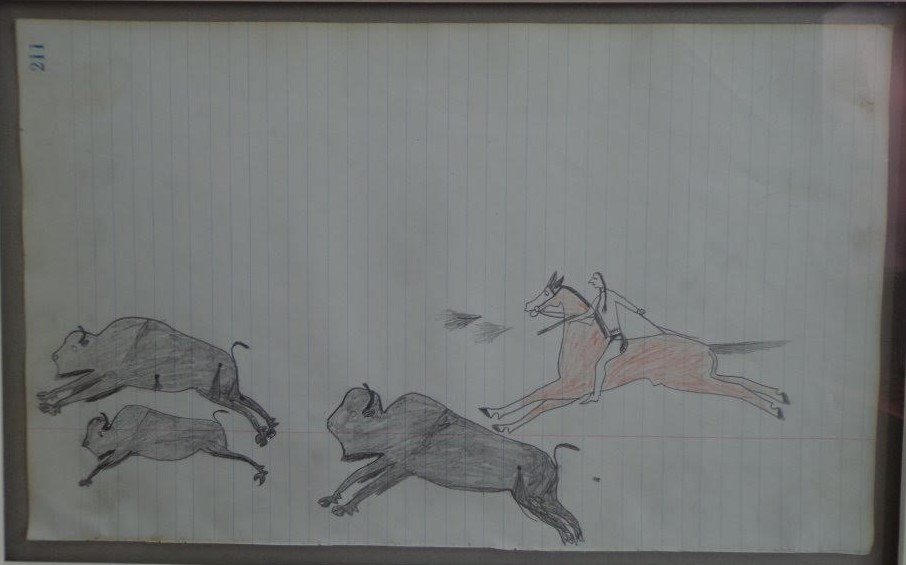
This drawing preserves a way of life already under threat at the time it was made.
The Amidon Ledger Book—discovered in Amidon, North Dakota—is a significant historical and artistic record created by several Sioux warriors. Its pages depict scenes of life before the full imposition of reservation confinement: hunting, warfare, horsemanship, and social experience remembered from a freer Plains existence.
This particular sheet presents a hunting scene, rendered in graphite and colored pencil. Unlike dramatic battle imagery, the focus here is pursuit—human, animal, and landscape arranged in purposeful motion. Plains ledger artists did not strive for Western-style perspective or naturalistic shading. Instead, they emphasized clarity of action. Identity is made legible through dress, posture, weaponry, and the relationship between hunter and prey.
By the 1880s, when many such drawings were executed, buffalo herds had been decimated and traditional seasonal migrations were no longer possible. Hunting scenes in ledger books were therefore not casual illustrations of daily routine; they were acts of recollection. The artists were documenting experience that younger generations might never know firsthand.
Ledger paper—originally intended for bookkeeping—became an unlikely canvas for cultural continuity. What had once been painted on hide now unfolded across ruled pages, a visual record made within a colonial administrative world.
The Amidon Ledger Book stands as both artwork and archive. It does not simply depict a hunt. It preserves embodied knowledge: how riders moved, how animals reacted, how skill defined survival.
The drawing is quiet, but its purpose is not. It asserts that memory belongs to those who lived it.