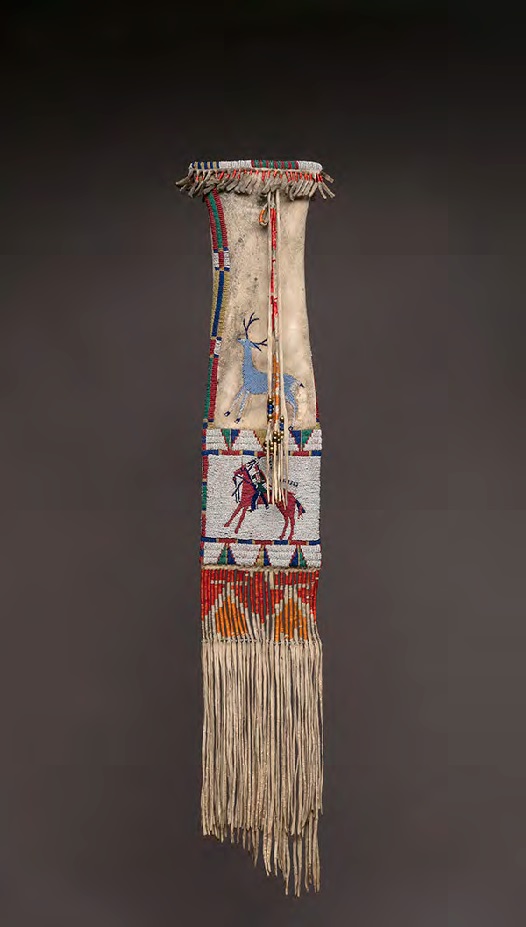
This is not simply a container. It is a collaborative narrative.
Constructed from native-tanned hide and fully beaded with sinew-sewn seed beads using an appliqué stitch, the bag carries a pictorial panel on its verso depicting two Sioux riders pursuing a fleeing Crow warrior. The scene unfolds against a blue ground—an intentional field that isolates action and heightens contrast.
Unlike ledger drawings, which rely on line and minimal color, this composition is built through bead mass and chromatic control. The protagonists are positioned decisively. Motion is directional. Identity is declared through posture and arrangement rather than background detail. Plains pictorial beadwork does not clutter space; it stages it.
Along the top edge of the scene, concentric semi-circles in yellow, green, pink, and blue create a rhythmic horizon line. The same palette carries across the flap, visually binding narrative and structure. Around the outer seams, wrapping lanes of red, yellow, and navy frame the bag like a border, containing and strengthening the composition.
Bags of this complexity were typically the result of shared labor. In Lakota communities, men often contributed narrative direction—describing battle exploits or hunting events—while women executed the beadwork itself with technical mastery. The result is not divided authorship but synthesis. Story and stitch are inseparable.
The Minneconjou, a division of the Lakota (Sioux), were part of the Cheyenne River Reservation by this period. By 1880, traditional warfare between tribal groups had largely ceased under federal enforcement, yet pictorial works continued to memorialize earlier conflicts. The bag becomes a portable record of remembered bravery.
Measuring 12 inches tall, 17 inches wide, and 3 inches deep, the scale alone signals ambition. This is not minimal ornamentation. It is a statement piece.
Ex Professor Guy Dubois, France (acquired before 1950), passed down by descent, and later published by Evan Mauer and Thomas Cleary (2022), with inclusion forthcoming in scholarship by Marsha Bol, Ph.D., this bag stands as a masterwork of Plains bead narrative.
It carries objects, yes.
But more importantly, it carries a story shaped by more than one set of hands.