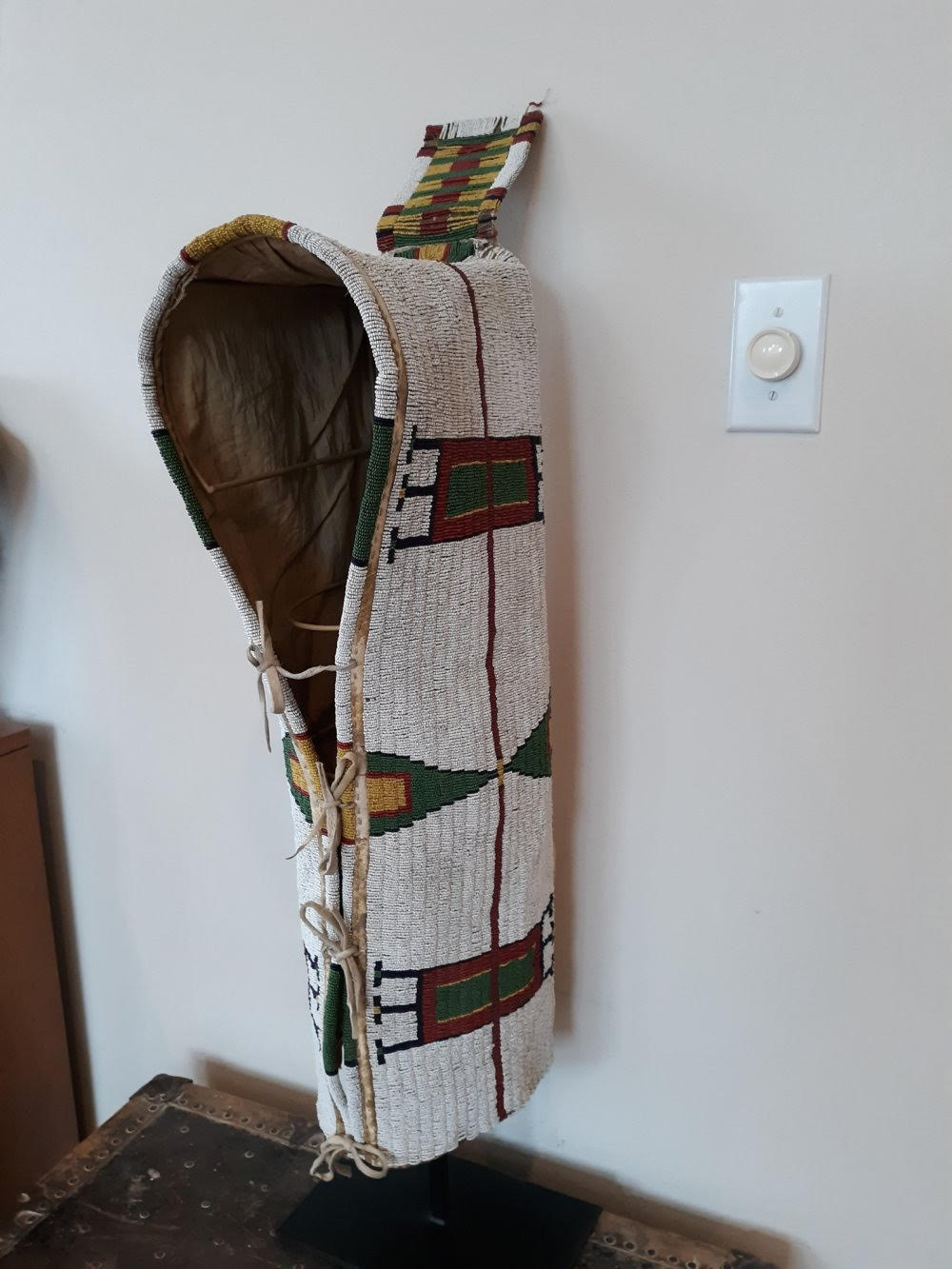
This cradle belongs to a moment of transition.
Dating to the 1870–1880 period, it features early examples of the lazy stitch technique—a beadwork method in which beads are sewn in short horizontal rows rather than individually attached. This approach produces bold blocks of color and strong graphic clarity, hallmarks of Sioux beadwork as glass beads became more widely available through trade.
The patterns reflect an early reservation-era aesthetic: confident geometry, strong color contrasts, and controlled repetition. Unlike later, denser compositions, early lazy stitch work often allows the structure of the design to breathe, emphasizing pattern architecture over surface saturation.
The traditional beaded flap at the top of the hood anchors the piece visually while serving a protective function. When raised, the hood shielded the infant’s head from wind and sun; when lowered, it revealed the beadwork as a statement of family and tribal identity.
The back of the cradle reveals an important detail: early recycled painted parfleche. Parfleche—rawhide that has been stretched, scraped, and painted—was traditionally used for containers and storage cases. Its reuse here speaks to both practicality and continuity. Painted parfleche carries its own visual tradition, rooted in abstract Plains design systems long predating widespread bead use.
An early muslin liner further marks this cradle as a product of cultural adaptation. Trade cloth had entered Plains life in increasing volume by this time. Rather than replacing Indigenous construction methods, muslin was incorporated into existing structural frameworks.
This cradle demonstrates a layering of eras: painted rawhide traditions, emerging beadwork techniques, and introduced textiles all working together. It reflects neither abandonment nor imitation, but integration.
Before a child ever walked the Plains—or the reservation—they were carried within an object like this, surrounded by pattern, protection, and inherited design language.