Before beadwork, before bells, before metal, there was pigment.
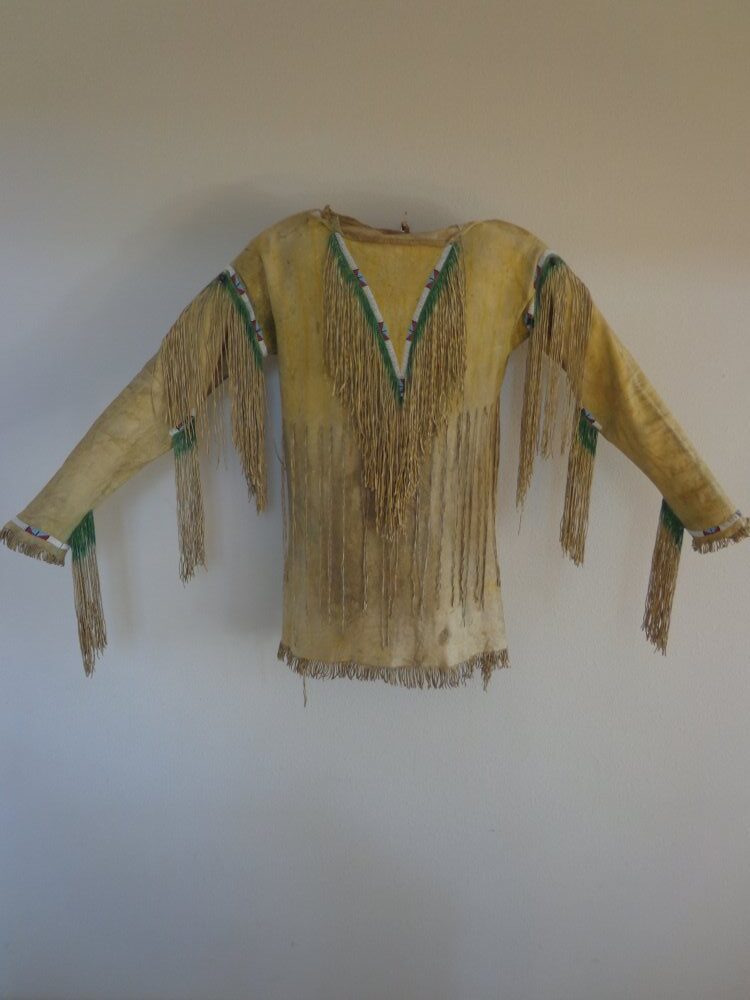
This Southern Cheyenne war shirt is grounded in earth color. Yellow ocher washes the hide, while a heavy green pigment concentrates at the base of the fringe. These are not casual applications. Ocher pigments—derived from mineral sources—carried spiritual and protective associations across Plains cultures. Color was understood not merely as ornament, but as power applied to the body.
The green pigment saturating the fringe base is particularly striking. Fringe moves with the wearer; as it lifts and falls, the band of color would animate, forming a shifting halo around the lower body. In motion, the pigment becomes active.
Across the sleeves, shoulders, and front and back bib panels appear classic Cheyenne bead colors and geometric patterning. The beadwork does not overwhelm the garment; it punctuates it. Cheyenne design systems are often marked by clarity and confident symmetry—balanced fields of red, blue, yellow, and white that sit in measured relation to one another.
The shoulders are further distinguished by mescal beads—small, cylindrical trade beads associated with mid-nineteenth-century Plains adornment. Their presence situates the shirt firmly within a dynamic trade era while remaining rooted in Cheyenne design authority.
Unlike later heavily beaded shirts that transform the entire surface into ornament, this example preserves a powerful dialogue between pigment and beadwork. The hide remains visible. The color breathes. The garment retains its organic presence.
By 1870, Southern Cheyenne communities were facing escalating military campaigns and displacement. War shirts of this period were not costumes; they were ceremonial and martial armor, activated through ritual, song, and vision.
Ex Steven Pickelner collection, this shirt stands as a study in restraint and force. It reminds us that in Plains regalia, power often begins with earth itself—ground mineral applied to living hide, worn against the skin.