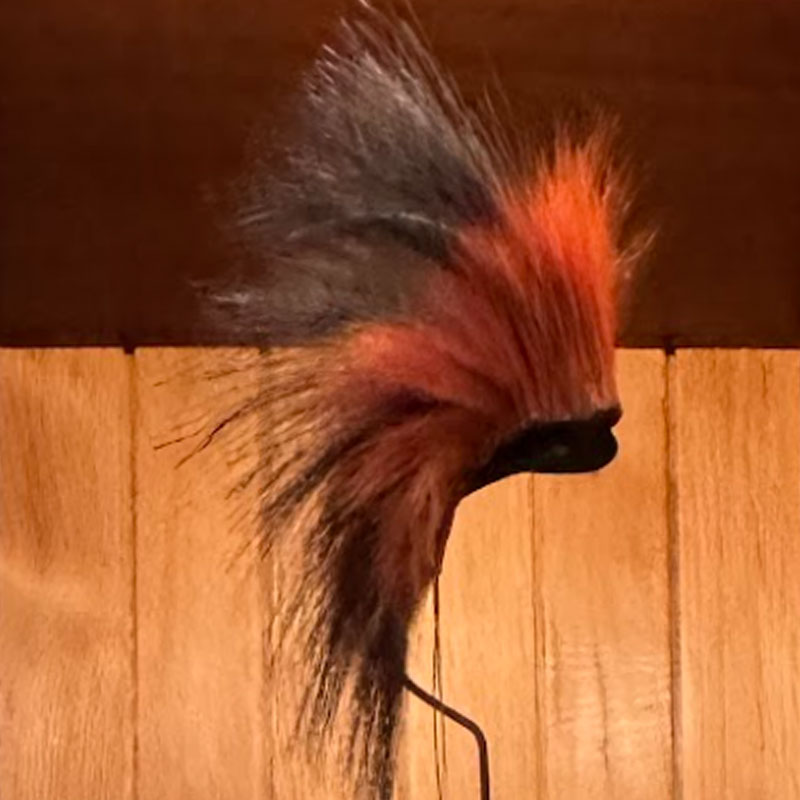
Hair-Based Construction with Turkey Beards
The roach was a traditional Plains men’s headdress worn across multiple Northern Plains cultures during the nineteenth century. Unlike full feathered war bonnets, the roach consisted of upright hair secured to a base, creating a narrow crest that ran from the forehead toward the back of the head.
This example is constructed on a hair foundation and incorporates naturally dyed deer hair along with turkey beards — the stiff, dark filament feathers taken from the breast of a wild turkey. Turkey beards were valued for their rigidity and tapering form, allowing the roach to stand upright in a dramatic arc.
The hair is dyed in warm tones, creating visual contrast against the darker beard filaments. Natural dyes derived from mineral and plant sources were commonly used prior to widespread synthetic colorants.
Roaches were often secured with a roach spreader and fastened to the scalp with ties. When worn, the crest followed the centerline of the head, emphasizing verticality. In motion — whether riding or dancing — the hair would tremble and flicker, amplifying physical presence.
Roaches were associated with male regalia and could indicate maturity, warrior status, or ceremonial participation. They were also practical in design: less cumbersome than full feathered headdresses, and suitable for mounted activity.
By the late nineteenth century, the roach had become a widely recognized Plains headdress form. Its construction required precision: evenly spaced hair bundles, careful stitching, and balanced curvature to maintain shape.
This object represents identity reduced to line and motion —
a controlled crest of hair that transforms the human profile.
It is restraint rather than abundance.
A disciplined arc rising from the head.