This object predates the bead-saturated Plains aesthetic most people recognize.
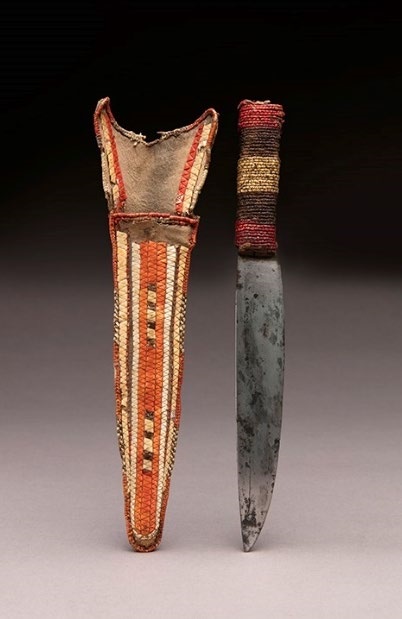
The sheath, narrow and tapering, is constructed from two pieces of finely tanned hide, carefully shaped and sewn into a precise form. Its surface is not beaded but quilled — decorated with ivory, orange, yellow, and dark brown dyed porcupine quillwork. The design employs zigzag patterning, linear bands, and edging techniques that predate the widespread adoption of glass seed beads.
Quillwork demands a different discipline than beadwork. Each quill must be softened, flattened, dyed, and wrapped or stitched into place. The surface produced is matte and tactile rather than reflective. It absorbs light instead of scattering it.
The upper perimeter of the sheath is cut in a subtle curvilinear silhouette, a reminder that form itself was considered as carefully as surface. Inserted within is a steel blade stamped with a crown, glass, and bottle — likely European trade marks. The presence of such a stamp situates the knife within eighteenth-century trade networks, when Indigenous communities integrated imported steel into long-standing craft systems.
The cylindrical handle is wrapped in red, yellow, and dark brown quillwork in a twisting pattern. Steel core. Indigenous skin.
Attributed tentatively to the Winnebago (Ho-Chunk), this object occupies a cultural crossroads — Great Lakes and Upper Mississippi design traditions merging with expanding European material exchange. It is both pre-reservation and early contact.
Unlike later Plains knife sheaths that emphasize bead brilliance and movement, this example is restrained and linear. The quillwork’s zigzags read almost architectural. There is clarity here, not exuberance.
Ex Paul Gray (NY), Ex John Painter (OH), and Ex Fred Cesana (CT), this sheath and knife stand as an earlier chapter in Native material history — one where quill, hide, and steel meet with quiet authority.
It is not loud.
It is foundational.